English
 русский
 Italiano
 Türkçe
 Deutsch
 اردو
اردو
Do you need a tour to travel around Egypt?
The short answer is:
No.
You can eat in Cairo without a guide.
Explore neighborhoods independently.
Take trains or buses between cities.
Use taxis or Uber.
Buy tickets for many museums and archaeological sites yourself.
Spend days beside the Red Sea doing absolutely nothing more complicated than deciding where to have dinner.
Egypt is not a country that can only be experienced through the window of a tour bus.
But there is a second question—and for most travelers, it is considerably more useful:
Should you do everything independently simply because you can?
That answer is also no.
The smartest Egypt itinerary often sits somewhere between complete independence and a fully organized holiday.
Explore the easy days yourself.
Get wonderfully lost when getting lost doesn't matter.
And organize the complicated days when distance, logistics or understanding what you're seeing can make the difference between simply reaching a place and genuinely experiencing it.
Yes.
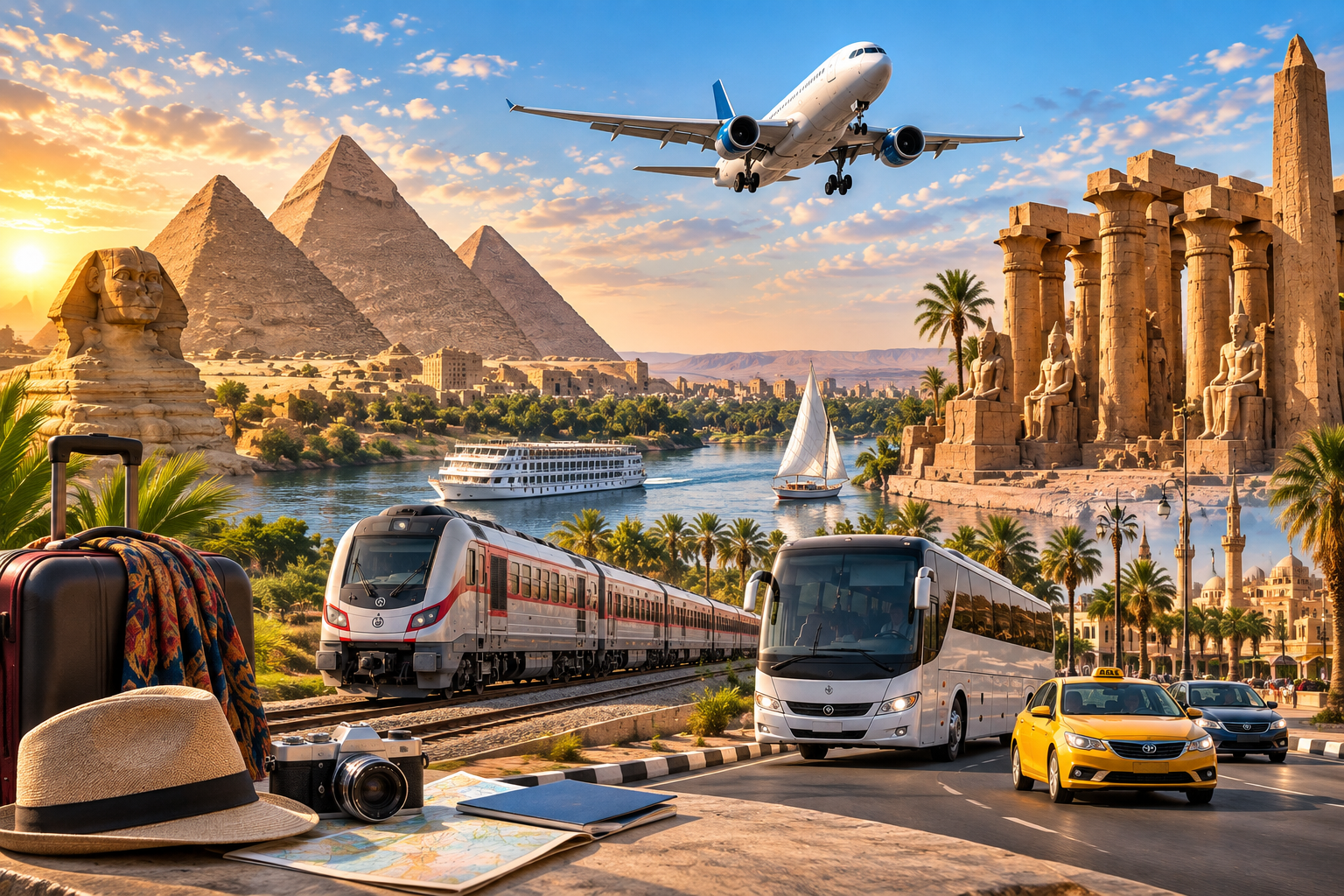
Egypt's official tourism platform lists trains, buses, taxis and Uber among the common transportation options available to tourists traveling within and between Egyptian cities. It also states that tickets for archaeological sites and museums can be purchased at the entrance or online through the Ministry of Tourism and Antiquities' official ticketing platform.
English is also widely understood in major urban centers and popular tourist destinations, although naturally you should never assume every person you meet speaks it.
In other words, there is no fundamental requirement that an international visitor must spend an Egyptian holiday permanently attached to an organized group.
Independent travel is entirely possible.
The more important issue is where independence adds freedom—and where it starts consuming your holiday time.
Let's begin with the part tour companies don't always tell you.
You do not need a tour for everything.
Want to spend an afternoon enjoying your resort in Sharm El Sheikh?
No tour needed.
Want to choose a restaurant, sit in a café, explore shops or enjoy a free evening?
You probably don't need somebody organizing that for you either.
Want a slow day where the entire point is having no itinerary?
Organizing it would almost defeat the purpose.
This matters because good independent travel creates something organized travel cannot always reproduce:
spontaneity.
You change your mind.
Stay longer somewhere you like.
Leave somewhere you don't.
Discover a café that wasn't in the plan.
Have lunch two hours later than expected because nobody is waiting for you.
Some of the best travel moments happen precisely because nothing was booked.
Independent travel tends to work best when the logistics are simple and the consequences of changing your plans are small.
A free afternoon in a city is very different from attempting to coordinate several distant archaeological sites before a return flight.
If the day contains one neighborhood, a meal and some wandering, independence can be liberating.
If you already understand the local transport system and have plenty of time, moving independently between destinations may also suit you perfectly.
And if you genuinely enjoy planning?
Even better.
Some travelers consider researching timetables, routes and tickets part of the adventure.
Others would rather eat their passport.
Neither is travelling incorrectly. 😄
The important thing is knowing which traveler you are.
This is where the equation changes.
Egypt is a large country.
The official Egyptian tourism guide specifically notes its size when discussing transportation and explains that flying can save time on long distances, while buses and trains offer less expensive alternatives that naturally require more travel time.
So imagine you have seven days in Egypt.
Saving money on transportation may look attractive.
But if doing everything independently requires extra hours researching routes, reaching departure points, waiting for connections and solving onward transportation after arrival, the real cost isn't only financial.
You are paying with holiday time.
This is exactly why we created our separate guide How to Get Around Egypt: Flights, Trains, Buses, Taxis or Private Transfers?
Transportation deserves its own decision.
Here, the important principle is simpler:
The more complicated the day becomes, the more valuable good organization can become.
Going somewhere is relatively easy.
Building a smooth day around several moving parts is harder.
Imagine an excursion involving hotel pickup, long-distance transportation, entrance tickets, several archaeological sites, lunch, guiding and a return journey.
You can potentially arrange many individual elements yourself.
The question is whether arranging them yourself is the experience you came to Egypt to have.
Sometimes freedom means doing everything yourself.
Sometimes freedom means somebody else already solved the boring parts.
There is another distinction travelers often miss.
A driver gets you somewhere.
A guide helps you understand why the place matters.
Egypt's official tourism platform states that licensed, experienced multilingual guides are available for private and group tours of museums and archaeological and cultural sites.
That doesn't mean every attraction requires a guide.
Sometimes you want to wander.
Museums can be enjoyable independently.
And experienced travelers may arrive having researched a site extensively already.
But Egypt contains places where context dramatically changes what you see.
A temple is impressive even when you know nothing about it.
Understand who built it, why particular scenes appear on its walls, how the complex developed and what its spaces were designed to mean—and suddenly you are looking at something different.
The stones haven't changed.
Your understanding has.
That is where a knowledgeable guide earns value that has nothing to do with transportation.
The comparison isn't simply:
cheap vs expensive.
Nor is it:
adventurous vs touristy.
Both are lazy comparisons.
The real differences involve freedom, time, effort, cost and depth of experience.
You decide when the day starts.
You decide when it ends.
Nobody cares if you spend 20 minutes somewhere or two hours.
You can change restaurants, routes and plans without consulting an itinerary.
And where public or urban transportation works for your journey, independent travel may also reduce costs.
The price of that freedom is responsibility.
Tickets.
Routes.
Timing.
Transport.
Research.
And solving whatever changes along the way.
A well-organized excursion should remove those decisions.
Pickup is arranged.
Transportation is coordinated.
The sightseeing sequence already makes sense.
Where guiding is included, historical context travels with you.
And somebody else is watching the clock.
That doesn't necessarily make the experience better.
But on the right day, it can make it much easier.
Organized travel becomes particularly attractive when the destination is far from your holiday base or when several components need to work together within limited time.
Consider a Cairo day trip from Sharm El Sheikh.
The objective isn't merely reaching Cairo.
You want to reach Cairo, experience major attractions, understand what you're seeing and return to Sharm within a carefully structured trip.
The same logic can apply to Luxor, where enormous archaeological significance is concentrated across multiple sites, or to excursions around South Sinai, where transportation often forms part of a larger planned experience.
Experience Egypt itself advises travelers booking outdoor activities to consult their hotel, guide or tour operator, while small and private tours can use specially licensed tourist vehicles.
Yalla Sharm currently offers organized experiences from Sharm ranging from Cairo and Luxor to Dahab, Ras Mohammed, White Island and desert activities, illustrating just how different the logistics can be between one excursion and another.
The common factor isn't that tourists are incapable of travelling independently.
It is that some days contain enough logistics that removing them improves the day.
This section matters just as much.
If you are perfectly comfortable getting somewhere yourself, understand what you want to see and value complete flexibility more than convenience, paying someone to organize the experience may add very little.
If the attraction is straightforward to reach and you want several unstructured hours there, independent travel may actually be better.
And if your perfect holiday afternoon consists of walking, stopping wherever looks interesting and having absolutely no idea where you'll be at 5 PM?
Please don't book somebody to give you a timetable. 😄
A tour is valuable when it solves a problem or adds something.
Not simply because it exists.
Choose independent travel more often if you enjoy research, want maximum flexibility, are comfortable solving transportation yourself and have enough time for plans to change without damaging the rest of your itinerary.
Choose an organized tour when your time is limited, the destination involves complicated logistics, you value historical interpretation, you're travelling a significant distance in one day or you simply don't want transport planning to become part of your holiday.
Families may also value organization differently from solo travelers.
A backpacker with three weeks available can absorb a missed connection very differently from a family trying to fit the Pyramids into a seven-night Red Sea holiday.
Neither traveler is more adventurous.
They simply have different things to lose when a day goes wrong.
This is the answer that disappears when travel articles insist on turning everything into a competition.
You don't have to choose.
Independent Egypt or organized Egypt is a false choice.
Do both.
Explore a neighborhood yourself.
Choose your own restaurants.
Spend a free evening wandering.
Use Uber when it makes sense.
Take a train or flight independently when that fits your itinerary.
Stay an extra hour somewhere simply because you love it.
Then, when you want to travel a long distance in one day, explore a complex historical destination or combine several experiences efficiently, organize that particular day.
This hybrid approach gives you something valuable:
freedom without forcing yourself to solve every logistical problem alone.
And for many travelers, that may be the sweet spot.
This is where Yalla Sharm fits into an independent Egypt holiday.
Not by taking over every day.
By making the difficult days easier.
Yalla Sharm already organizes experiences across Sharm El Sheikh and beyond, including Cairo, Luxor, Dahab, Ras Mohammed, White Island and desert adventures. Its current website also offers transportation services in several Egyptian destinations.
So you can keep the parts of Egypt that are easy to explore independently exactly that way.
Your café.
Your free afternoon.
Your shopping.
Your slow morning.
Your spontaneous evening.
And when the alarm is going off before sunrise because tomorrow involves another city, several major sights and hundreds of kilometers?
That can be the day you let somebody else handle the clock.
Good organized travel shouldn't take freedom away from an Egypt holiday.
It should protect your freedom for the moments when you actually want it.
No.
And that's precisely why the decision becomes interesting.
Egypt can accommodate travelers who want structure and travelers who want independence.
You can move between and within cities using multiple forms of transportation, visit many attractions independently and build large parts of your itinerary yourself.
You can also use licensed guides, tourist transportation and organized excursions when they add enough convenience, knowledge or saved time to justify them.
So don't ask:
“Should I visit Egypt independently or with tours?”
Ask:
“Which parts of my Egypt trip are better when I do them myself—and which are worth organizing?”
That's a much better way to travel.
Because the goal isn't to prove that you can do Egypt alone.
And it isn't to have every hour planned for you.
The goal is to return home feeling that your holiday belonged to you.
Explore the easy days freely. Organize the complicated ones intelligently. And leave enough space between them for Egypt to surprise you. 🇪🇬✨
Egyptian Hospitality: Why Visitors Are Often Treated Like Guests 🇪🇬🤍 You may come to Egypt expecting the Pyramids. The Nile. Ancient temples...
Read MoreHow to Get Around Egypt: Flights, Trains, Buses, Taxis or Private Transfers? 🚆✈️🚐 Look at Egypt on a map and planning a multi-city holiday can se...
Read MoreBeyond Koshari: What Egyptians Really Eat in Everyday Life 🇪🇬🍽️ Ask travelers to name an Egyptian dish and one answer appears almost immediately:...
Read MoreCairo from Sharm El Sheikh: Plane vs Bus — Which Is Better? ✈️🚌 You have decided the Pyramids are worth leaving the beach for. Now comes...
Read More24/7